
Automatic geometry
Curvature changes the clamp geometry
The machine automatically adapts clamp position to the drawer dimensions and shape instead of treating every drawer as a fixed rectangle.
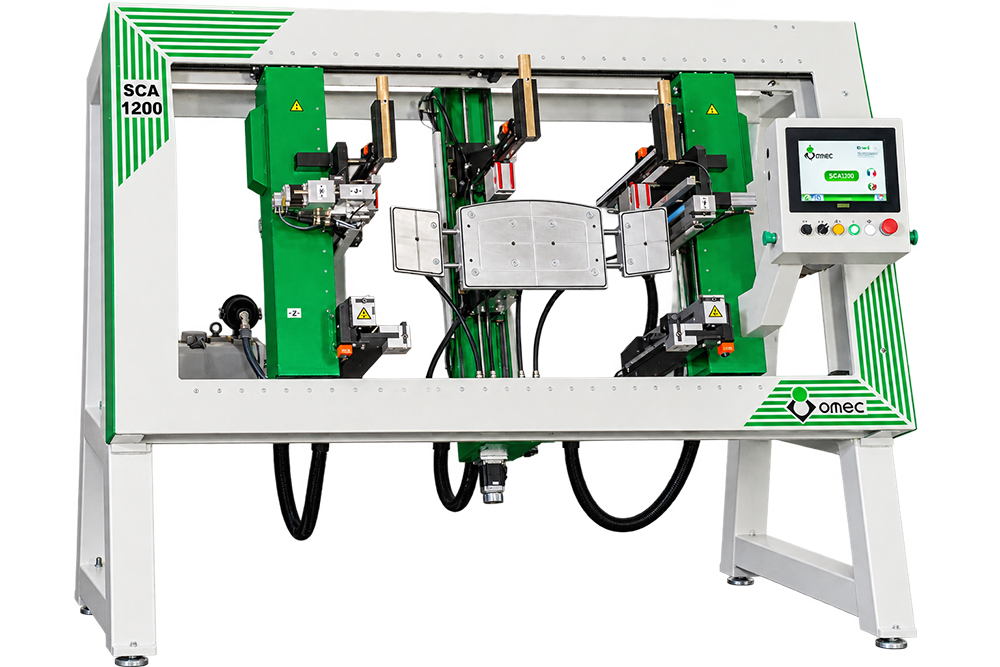
OMEC’s automatic seven-axis clamping platform for straight and curved dovetail drawers built from five separate elements, with or without a bottom. The SCA 1200 automatically adapts clamp positions to changing drawer dimensions and curvature while its numerical control manages drawer width, side length, central drawer length, vacuum-cup position and bottom-groove position.
Drawer assembly becomes harder when width, side length and front curvature vary across the product family.
Seven controlled axes automatically reposition the clamping system around the programmed drawer geometry and curvature.
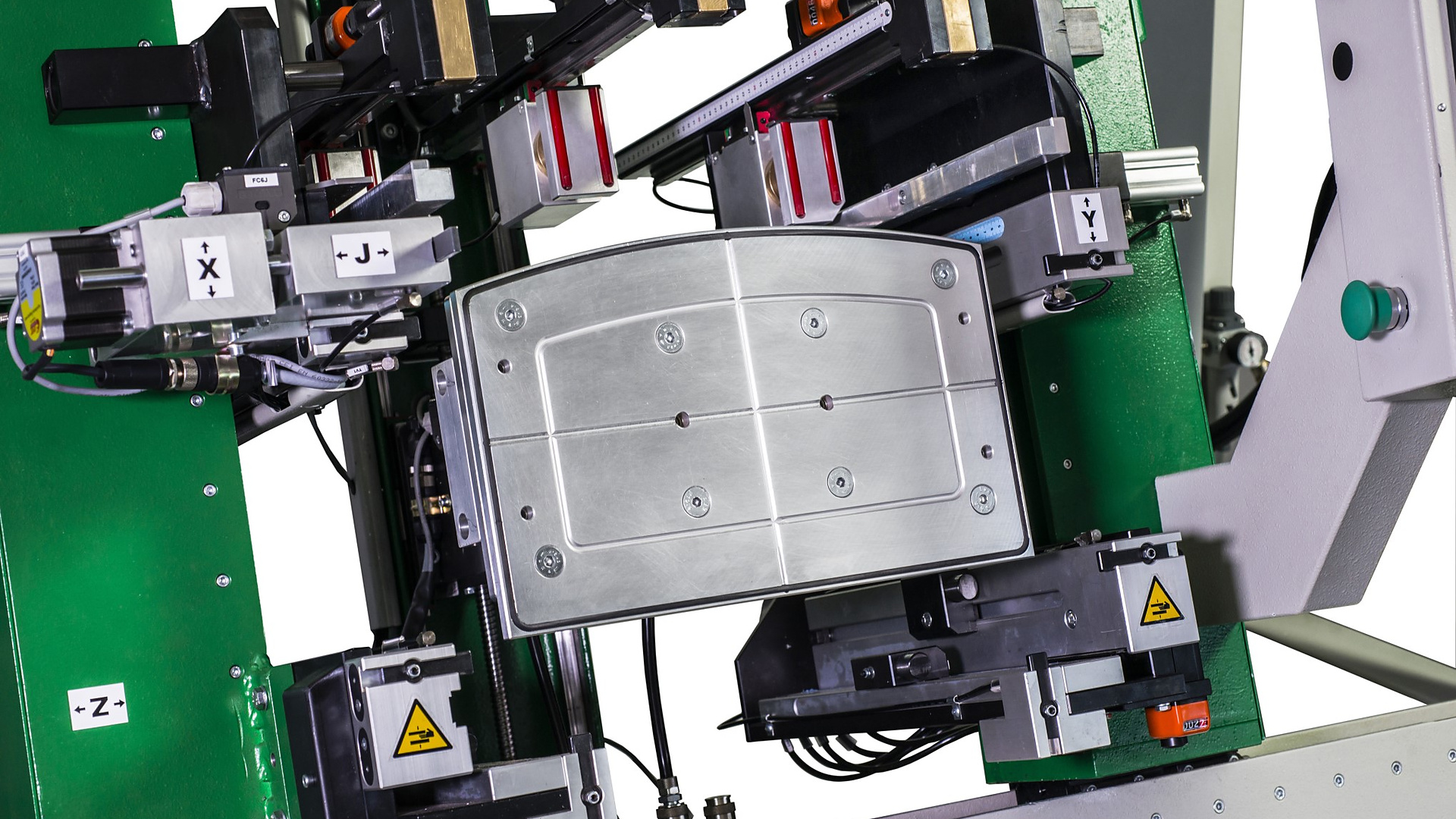
A vacuum system holds the drawer bottom in position while the control can change both vacuum-cup position and bottom-groove position.
Start with the manufacturing problem
The SCA 1200 is built for manufacturers whose drawer program extends beyond simple straight rectangular assemblies. OMEC explicitly supports straight drawers and curved configurations including symmetrical, asymmetrical, concave, convex and mixed forms.
The machine automatically adapts clamp position to the drawer dimensions and shape instead of treating every drawer as a fixed rectangle.
OMEC designed the SCA 1200 around dovetail drawers made from five separate elements.
The numerical control can change both the vacuum-cup position and the bottom-groove position.
Machine production is referenced at 100 drawers/hour. Actual line output still depends on loading, upstream joint/glue preparation, drawer geometry and downstream handling.
Application fit
The SCA 1200 is a strong fit for straight and curved drawer programs using dovetail joints and five separate elements, with or without a bottom. It is not the same product as the SCM 1200 manual press and should not inherit manual-machine limitations or data.
OMEC explicitly includes straight drawers in the SCA 1200 assembly scope.
Curved symmetrical drawer forms are part of the SCA 1200 application range.
OMEC also identifies asymmetrical curvature.
The SCA 1200 supports concave, convex and mixed front-board curvature combinations.
The five-element drawer can be assembled with or without the bottom, while the vacuum system is used when the bottom must be held in position.
This SCA 1200 application is tied to dovetail-jointed drawers; peg-only or other non-dovetail constructions should be qualified separately.
Select the assembly process from the drawer backwards
The SCA 1200 decision is driven by the complete drawer family. Its control flexibility is useful only if the customer’s minimum, maximum and curved configurations fit the machine’s exact dimensional envelope.
Straight, symmetrical curve, asymmetrical curve, concave, convex or mixed front geometry.
Validate width, depth, height and front projection against the SCA 1200 working limits.
Verify five separate elements and the upstream dovetail-joint preparation.
Confirm whether the drawer has a bottom and where the vacuum cup and bottom groove need to sit.
Compare the 100-drawer/hour machine reference against upstream jointing/gluing and downstream handling.
Machine architecture / work cycle
OMEC describes the machine as a seven-axis automatic clamping machine with numerical control. Its defining behavior is automatic adaptation of clamp positions to the programmed drawer dimensions and curvature.
The SCA 1200 uses seven controlled axes.
Clamp positions adapt automatically to the drawer’s dimensions and shape.
Commands are made through a pushbutton panel and touch-screen control panel.
Adjustments are carried out by following the machine software instructions displayed on the monitor.
Drawer geometry capability
The SCA 1200 application range includes straight, concave, convex, asymmetrical and mixed drawer geometries.
Drawer geometry
The SCA 1200 supports straight drawers, curved symmetrical drawers, asymmetrical drawers and fronts with concave, convex or mixed curvature. The machine automatically adjusts clamp position around those changing forms.
Technical framework
The SCA 1200 technical framework includes installed power, working pressure, drawer production, machine weights and overall machine dimensions.
| Field | Machine value | North American reference |
|---|---|---|
| Machine type | 7-axis automatic clamping machine with numerical control | Straight / curved dovetail drawer assembly |
| Installed power | 4 kW | ~5.36 hp |
| Working pressure | 0.7 MPa | ~101.5 psi |
| Drawer production | 100 n/h | 100 drawers/hour machine reference |
| Machine weight | 980 kg | ~2,161 lb |
| Packed machine weight | 1180 kg | ~2,601 lb |
| Overall dimensions L × W × H | 160 × 220 × 180 cm | ~63.0 × 86.6 × 70.9 in |
Dimensional range / drawer envelope
The customer’s complete drawer family must remain inside the workpiece envelope before curve flexibility is evaluated.
Controls / automation / operator workflow
The SCA 1200 numerical control changes five defined drawer-position variables within the machine limits.
The control can change drawer width within the machine’s working limits.
Side-panel length is one of the machine’s programmable variables.
The central drawer length is separately adjustable in the program.
The control can reposition the vacuum unit used to hold the drawer bottom.
Bottom-groove position is a programmable variable.
All adjustments are performed by following the software instructions displayed on the machine monitor.
Vacuum / clamping architecture
The SCA 1200 combines seven-axis automatic clamp positioning with a vacuum system that holds the drawer bottom during assembly.
A vacuum system keeps the drawer bottom in position.
The machine automatically adjusts clamp positions according to drawer dimensions and shape.
The machine working-pressure value is 0.7 MPa.
Actuator, pressure-system and electrical service procedures remain with OMEC documentation and trained personnel.
Utilities / deployment
Installed power is 4 kW and working pressure is 0.7 MPa. Voltage, phase, frequency and branch-protection requirements are defined with the supplied machine and final installation package.
Installed power is 4 kW.
Working pressure is 0.7 MPa, approximately 101.5 psi.
Final Canadian voltage, phase, frequency and branch-protection requirements are defined with the supplied machine at quotation.
The standard configuration includes aluminum plates for the vacuum system; A99 is a custom-made vacuum-unit option.
Plan around the 160 × 220 × 180 cm machine envelope plus practical loading, drawer removal and service access.
Final setup, program verification and operator training belong to qualified commissioning.
Production-rate framework
Use 100 drawers/hour as the machine reference; sustained production depends on the full drawer process and line balance.
Use 100 drawers/hour as the machine production reference.
Straight and curved drawers may create different operator loading and upstream preparation conditions.
The SCA 1200 assembles prepared dovetail drawer components; machining and adhesive processes can become the line bottleneck.
Finished drawer removal, cure/handling and subsequent production stages remain part of the total line rate.
Ownership / changeover
The SCA 1200 uses repeatable software-driven repositioning across changing drawer shapes. Program discipline, vacuum-system condition, component preparation and clean working surfaces remain important to reliable production.
Keep width, side length, center length, vacuum position and bottom-groove position tied to the actual drawer construction.
The bottom-holding system is central to drawers assembled with a bottom; maintain it using OMEC service documentation.
The machine automatically adapts its clamps, but the five drawer elements still need to arrive in the correct construction and condition.
Plan access around the control panel, clamping area and machine frame for inspection and qualified maintenance.
Production-line integration
The automatic clamp is most useful when the upstream process can feed a changing drawer mix and the downstream process can keep pace with the 100-drawer/hour machine reference.
Machine the five drawer elements and bottom geometry to the qualified product design.
Control the approved glue process before the components reach the clamp.
Load the appropriate width, side/center length, vacuum and bottom-groove positions.
The seven-axis system automatically positions around the straight or curved drawer geometry.
Move the assembled drawer into the next production stage while keeping the automatic clamp supplied.
Standard configuration / options
The SCA 1200 configuration shown here includes four standard components and two customer-specific options.
Part of the standard machine configuration.
The standard machine includes aluminum plates for the vacuum system.
A lower support plate for broad drawers is listed as standard equipment.
The user/instruction manual is part of the standard configuration.
A99 is a customer-specific vacuum-unit option.
A52 provides optional programs supplied on customer request.
Curve qualification
The SCA 1200 supports curved symmetrical, asymmetrical, concave, convex and mixed drawer forms. Curved geometry is qualified from customer drawings and the final program/configuration.
Business-case framework
The economic case should compare manual curved-drawer setup, existing changeover time, product mix, drawer geometry, upstream dovetail/glue capacity and downstream handling.
Measure how often drawer width, depth, height and curvature change across the production mix.
Quantify the manual clamp/fixture changes required by the existing process.
Evaluate how much of the drawer family can be captured in repeatable SCA 1200 programs.
Compare the 100-drawer/hour machine reference with the slowest upstream or downstream process.
Application data package
The strongest qualification package includes minimum and maximum drawer dimensions plus drawings of the most demanding curved configurations and bottom geometry.
Width, depth, height, front projection and drawings for straight/curved products.
Symmetrical/asymmetrical, concave/convex/mixed shape and actual CAD/drawing geometry.
Five-element dovetail construction, bottom/no-bottom, bottom-groove location and upstream adhesive process.
Existing output, target drawers/hour, batch size, product mix, electrical service and surrounding line equipment.
Complete at quotation
Your complete OMEC SCA 1200 proposal defines the drawer width/depth/height/front-projection range, straight and curved drawer geometries, five-element dovetail construction, bottom configuration, vacuum hardware, A99 custom vacuum unit if required, A52 optional programs, electrical configuration, 0.7 MPa working-pressure interface, machine dimensions, commissioning, operator training and role in the complete drawer-production process.
The proposal also validates the customer’s actual curved drawer drawings and the final programmed geometry.
SCA 1200 FAQ
The key qualification is not simply drawer size—it is the combination of dimensions, curvature, bottom geometry and production mix.
It is a seven-axis automatic numerical-control clamp for five-element straight and curved dovetail drawers, with or without a bottom.
Supported curved forms include symmetrical curves, asymmetrical curves, concave, convex and mixed front-board configurations.
Drawer width, side length, central drawer length, vacuum-unit position for the bottom, and bottom-groove position.
A vacuum system keeps the drawer bottom in position.
The machine production reference is 100 drawers/hour.
Width 230–1200 mm, depth 50–350 mm, height 230–600 mm and front projection 0–30 mm.
Curved geometry is qualified from the actual drawer drawing and final program/configuration.
Standard equipment shown here includes a tool kit, aluminum vacuum plates, a lower support plate for broad drawers and the instruction manual.
A99 is a custom-made vacuum-unit option; A52 is optional programs supplied on customer request.
OMEC SCA 1200 application review
Titan can qualify the SCA 1200 against straight and curved drawer geometry, dimensional range, dovetail construction, bottom/vacuum requirements, program changes, output target and surrounding drawer-production process.
Useful inputs: minimum/maximum width, depth and height, front projection, CAD/drawings of curved fronts, bottom/no-bottom construction, bottom-groove position, current assembly method, target drawers/hour, batch sizes, changeover frequency and electrical service.