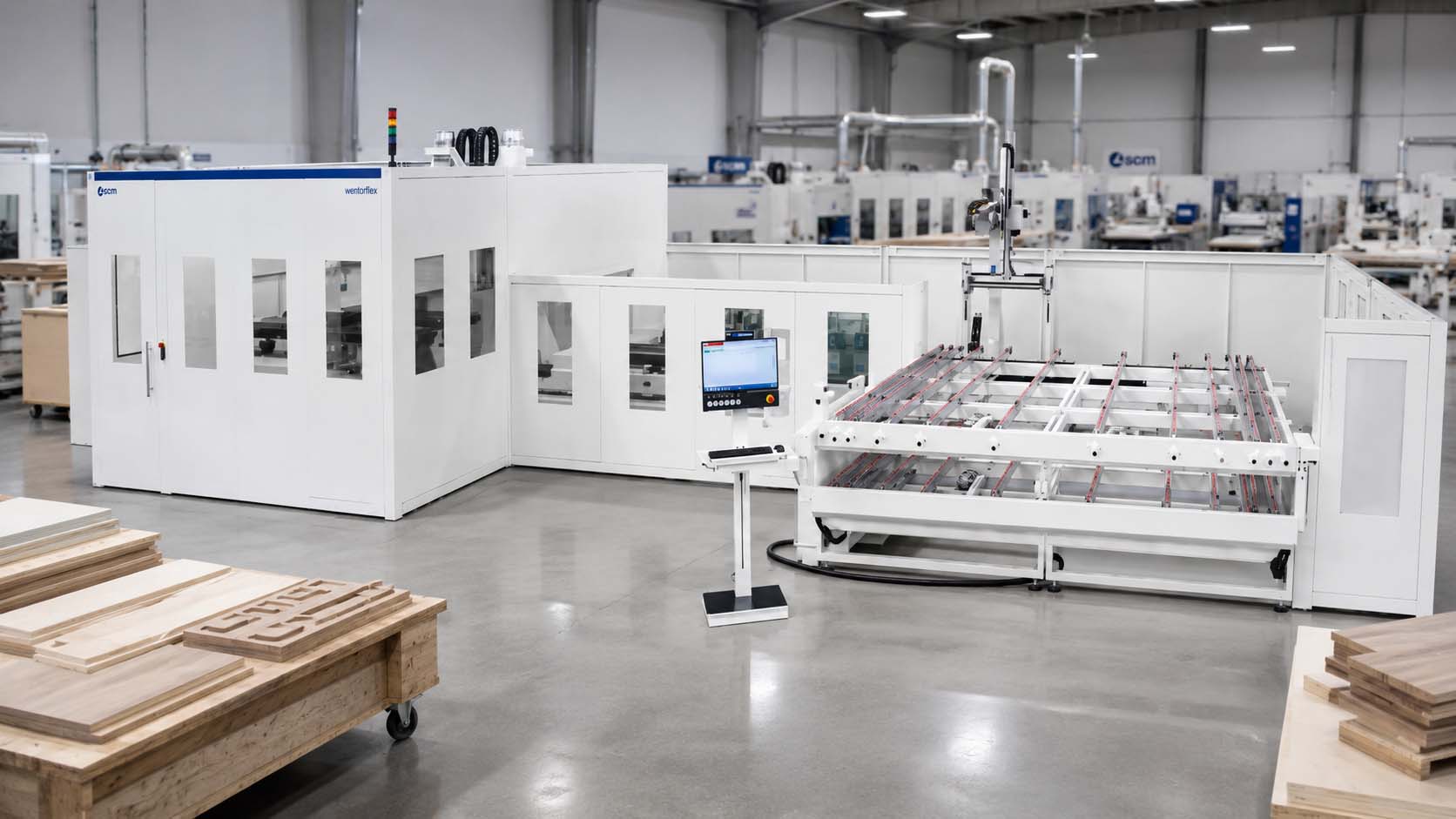
SCM WindorFlex 1 CNC Machining Cell for Windows & Doors
The scalable WindorFlex cell for longer workpiece capacity, automated loading and unloading, 4- and 5-axis machining flexibility, and a clear growth step above the compact WindorFlex CP.
The growth-stage WindorFlex platform for longer components and broader handling options.
SCM WindorFlex 1 is a CNC machining cell for wood window and door manufacturers that need more capacity and flexibility than the compact WindorFlex CP, without immediately stepping into WindorFlex 2-level productivity.
The system is designed around longer workpiece platforms, dedicated clamping, automated loading and unloading, high-speed axis movement, and configurable 4- and 5-axis machining architecture for complete window and door component production.
Final customer-facing publishing should follow the quoted Canadian configuration, including selected platform length, handling layout, spindle package, tool store, software integration, extraction, electrical, installation, startup, and service path.
3500 / 4500 / 6000 mmPlatform Length Families
40–260 mmWorkpiece Width
35–160 mmWorkpiece Thickness
100 / 80 / 50 m/minX-Y-Z Axis Speeds
Capability Matrix
Window & Door Production Modes
Configure WindorFlex 1 around workpiece length, handling layout, spindle package, tooling, software, and the exact product family being machined.
Mode 01
Profile Machining
Machine window, sash, door, and frame profiles with the selected spindle package and tooling configuration.
Mode 02
Drilling & Routing
Complete drilling, milling, recessing, routing, and complementary component machining within the programmed cycle.
Mode 03
4- / 5-Axis Flexibility
Use configurable electrospindle architecture to support more demanding geometry and expanded process flexibility.
Mode 04
Automated Handling
Confirm front bench, side bench, two handling devices, or anthropomorphic robot layouts based on the production flow.
Mode 05
Software Workflow
Maestro Active Windoor supports the working process, while connected workflow options should be confirmed during quoting.
WindorFlex 1 is built for longer window and door components, broader handling strategies, and a stronger production conversation than the compact CP platform.
Fixed-Gantry Accuracy
Range documentation positions the machine around a fixed-gantry structure, stabilized electro-welded steel, and stiffening in high-stress areas.
Handling Configuration Range
Confirm the exact loading and unloading architecture, from bench-based layouts through more automated handling concepts, according to the cell plan.
Maestro Active Windoor
Window-specific software supports control and process optimization, while Maestro Connect, barcode, labels, KPI, and reporting can be confirmed per quote.
Equipment Range
Lineup Positioning
Compact Cell
WindorFlex CP
Best when footprint and controlled investment matter most, with one 3300 mm platform and compact automatic production.
SCM WindorFlex 1
Best Growth Platform
Best when the customer needs longer workpiece flexibility, automated handling, and a scalable production step above the compact CP configuration.
High-Output Cell
WindorFlex 2
Best when the application requires the highest productivity architecture and double-worktable throughput in the WindorFlex range.
Technical Specifications
SCM WindorFlex 1
Machine Profile
Manufacturer
SCM
Model
WindorFlex 1
Machine Type
CNC machining cell for wood window and door manufacturing
Primary Use
Window frames, sash components, door frames, profiles, and related joinery
Workpiece Length Platforms
Platform 1
1 × 3500 mm or 2 × 1700 mm
Platform 2
1 × 4500 mm or 3 × 1245 mm
Platform 3
1 × 6000 mm or 4 × 1160 mm
Minimum Length
220 mm minimum, or 160 mm with a specific cycle
Workpiece Section
Workpiece Width
40–260 mm
Workpiece Thickness
35–160 mm
Bench Capacity Reference
Up to 27 components at 60 mm width, or 54 in pairs
Height Reference
Approx. 3100–3800 mm if the 5-axis unit is provided
Axes & Machining Unit
Maximum X-Y-Z Axis Speed
100 / 80 / 50 m/min
Standard Electrospindle Power
20 kW
Electrospindle Configuration
Configurable 4- and 5-axis electrospindles
Tool-Chuck Note
HSK 63F plus and HSK 63E packages referenced in range documentation
Tooling, Handling & Layout
Standard Tool Store
1 × 48 positions
Optional Tooling Note
Two 48-position chain tool stores shown as a configuration concept
Loading / Unloading
Bench or robot handling depending on final system layout
Front-Bench Layouts
Approx. 14500 × 8000 mm, 17300 × 8000 mm, or 21200 × 8000 mm
Selected handling layout, spindle package, tool store, extraction, and electrical are confirmed by quote
Support
Layout review, installation, startup, training, warranty, and service confirmed by quote
Production Environments
Where the WindorFlex 1 Fits
For window and door manufacturers that need a scalable automated cell with longer component capacity and stronger growth potential than the compact CP platform.
Door-frame components, profile-based joinery, routing, drilling, and machining operations where 4-/5-axis flexibility and longer members matter.
Architectural Joinery
Custom openings, heritage-style windows, specialty components, and high-value joinery where repeatability and accuracy are critical.
Legacy Showcase
Use the isolated machine view to reinforce platform scale, cell structure, and handling layout.
WindorFlex 1 should be positioned as a production-system conversation: automated handling, longer component capacity, flexible spindle architecture, tool-store options, and window-specific software.
The key advantage over WindorFlex CP is longer workpiece flexibility. WindorFlex 1 supports 3500 mm, 4500 mm, and 6000 mm platform families while scaling the handling layout to match production needs.
Final quoting should confirm selected platform length, handling architecture, spindle package, 20 kW standard power versus any package-dependent optional power, tool store, software workflow, extraction, electrical, layout, installation, training, warranty, and support.