
CNC Machinery
Flat table and nesting CNC routers built for batch-one production, clean sheets, and serious throughput.
Flat table and nesting CNC routers are the production heart of modern cabinet, casework, closet, furniture, fixture, door, and millwork shops. They turn full sheets into finished parts, drill hardware patterns, manage small-part hold-down, route profiles, machine MDF, plywood, melamine, TFL, veneer panels, plastics, composites, and specialty panels — all while feeding edgebanders, dowel cells, assembly, sanding, and finishing.
Nesting CNC routers are where material, software, tooling, and production discipline meet.
A nesting CNC is not just a router table. It is a production system. The machine has to hold the sheet, cut clean parts, drill accurately, manage dust, preserve small components, reduce waste, and produce edges that are ready for edgebanding, sanding, painting, or assembly. Titan’s flat table and nesting CNC lineup gives shops a path from first-step nesting through high-output production cells and advanced 5-axis machining.
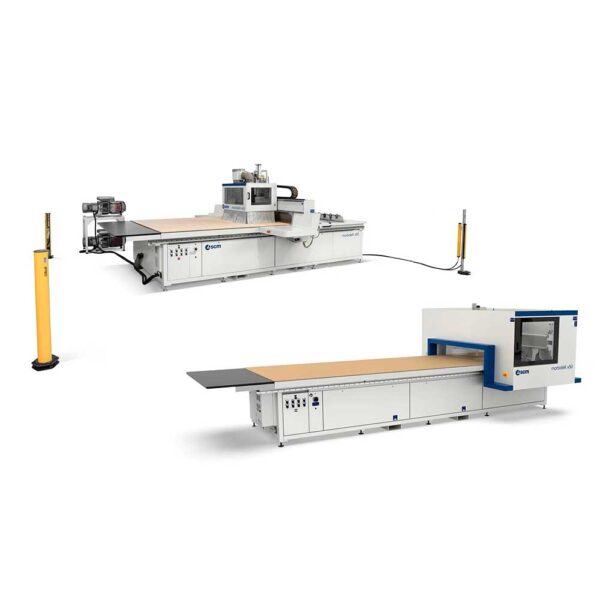
Entry-Level Production Control
The right first nesting CNC gives a shop better part accuracy, faster sheet processing, repeatable drilling, reduced manual layout, and a cleaner path toward real production reporting.
View Morbidelli X50 →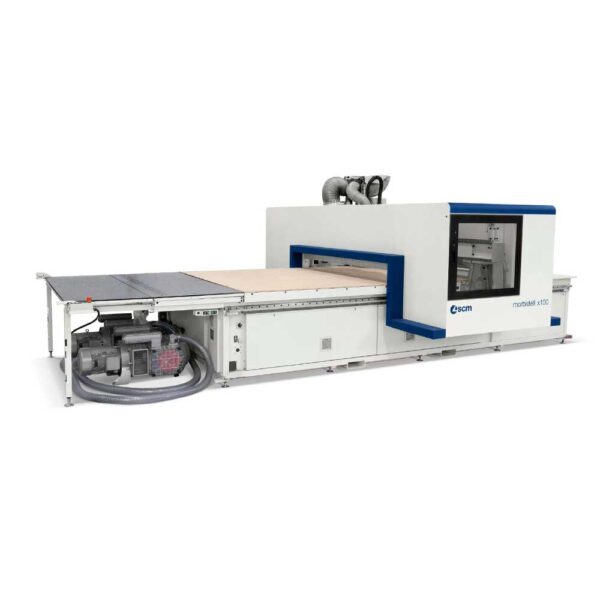
Flexible Shop Performance
Batch-one production requires smart cutting order, reliable vacuum zoning, drilling integration, and software discipline so custom jobs can flow without constant operator rescue.
View Morbidelli X100 →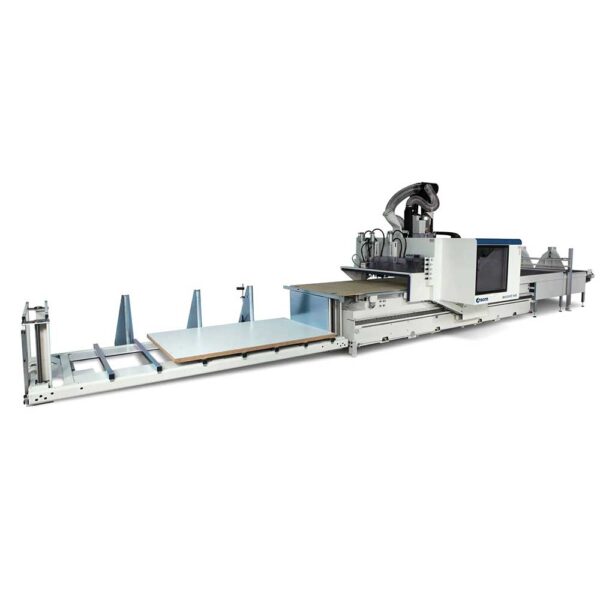
Routing, Profiling, and 5-Axis Work
When a shop needs heavy profiling, flexible production, automatic loading/unloading, and advanced machining heads, the CNC becomes a central manufacturing cell.
View Accord NST →The CNC is where the shop either scales — or starts drowning in remakes.
Bad vacuum, dull tooling, wrong chip load, poor spoilboard management, weak dust extraction, bad labels, unstable small parts, and poor software workflow all create downstream pain. Edgebanding problems, missing holes, damaged parts, slow assembly, paint defects, and install stress often start right here at the nesting table.
Plan My CNC CellSCM flat table and nesting CNC lineup from Titan Equipment.
Titan’s current category includes compact CNC systems, first-step nesting machines, high-output Morbidelli nesting centers, automatic loading/unloading solutions, and advanced machining centers for profiling, doors, panels, windows, and complex woodworking.
SCM Morbidelli X50
The Morbidelli X50 is conceived for shops taking a first step into nesting technology. It includes a High Grip Vacuum worktable, Smart Cut algorithm, SMS Spoilboard Management System, and removable XS Device for referencing small pieces that cannot reach the stops.
Key specs: working areas up to 4356 x 2216 mm, PRO-SPEED vectorial speed up to 57 m/min, PRO-SPACE speed up to 47 m/min, 140 mm Z-axis panel passage, 9.5 kW routing power, 24,000 rpm, 12 tool positions, 12 vertical spindles, 6 horizontal spindles, and integrated 125 mm blade.
View SCM Morbidelli X50 →
SCM Morbidelli X100
The Morbidelli X100 is designed for flexible performance and productivity in batch-one production. Vacuum Management controls suction zones during processing, while X-PODs enable machining without removing the spoilboard and allow accurate referencing with a cross-laser system.
Key specs: working areas up to 4356 x 2216 mm, PRO-SPACE vectorial speed 70 m/min, 150 mm Z-axis passage, up to 15 kW routing power, 24,000 rpm, 31 tool positions, 16 vertical spindles, 8 horizontal spindles, and up to 2 integrated blades.
View SCM Morbidelli X100 →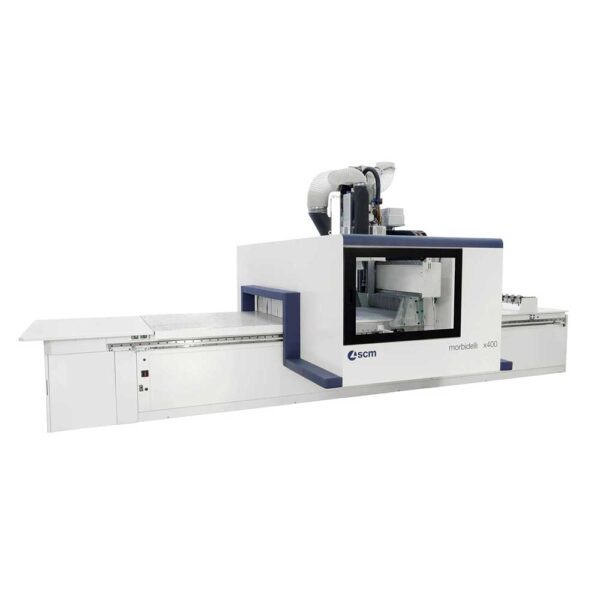
SCM Morbidelli X200/X400
The Morbidelli X200/X400 series is engineered for flexible batch-one production with high configurability. X-PODs, JQX 5-axis electrospindles, 3D operations without spoilboard removal, high-speed nesting, advanced drilling heads, FAST tool changers, and X-Vacuum support demanding modern production.
Key specs: working areas up to 4356 x 2216 mm, vectorial speed up to 84 m/min PRO-SPACE or 113 m/min PRO-SPEED, 150/180 mm Z-axis passage, up to 15 kW 3/4-axis routing, up to 13.5 kW 5-axis routing, up to 53 tool positions, 21 vertical spindles, 12 horizontal spindles, and integrated blades.
View SCM Morbidelli X200/X400 →
SCM Accord NST
The Accord NST is equipped with automatic loading and unloading for single-operator control of the work cycle. It processes lamellar wood, plywood, chipboard, and MDF, combines heavy-duty profiling with PRISMA 5-axis machining heads, and uses MAESTRO software for intelligent programming.
Key specs: working areas up to 4250 x 2120 x 350 mm, X/Y/Z speed up to 90/90/30 m/min, 15 kW electrospindle power, and 24,000 rpm spindle speed.
View SCM Accord NST →
SCM Morbidelli M100/200
The Morbidelli M100/200 is a modular 5-axis machining center for modern woodworking. It supports panels, doors, windows, flexible modules, JQX spindle heads, RO.AX high-speed drilling units, FAST14 tool changers, TV FLEXMATIC work tables, and optional dowel insertion with pearl glue.
Key specs: working areas up to 5510 x 1620 mm, vectorial speeds up to 56 m/min PRO-SPACE or 78 m/min PRO-SPEED, 180/250 mm panel passage, 15 kW routing power, 24,000 rpm, up to 60 tool positions, 21 vertical spindles, 12 horizontal spindles, and 125 mm integrated blade.
View SCM Morbidelli M100/200 →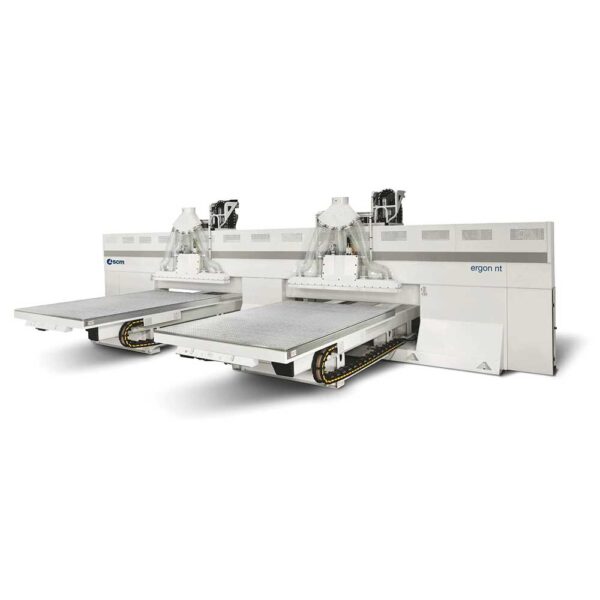
SCM Ergon NT
The Ergon NT is built for integration in line with automatic loading and unloading. Its stiff fixed-gantry structure supports precision across the entire work area, up to four machining heads, safe loading-zone access, independently moving tables, and the ability to run two different programs at the same time.
Key specs: X-axis working area from 3680 to 6360 mm, Y-axis working area from 1560 to 3120 mm, 280 mm component passage, 12 onboard tool-change positions for each head, and up to 48 lateral side tool-change positions.
View SCM Ergon NT →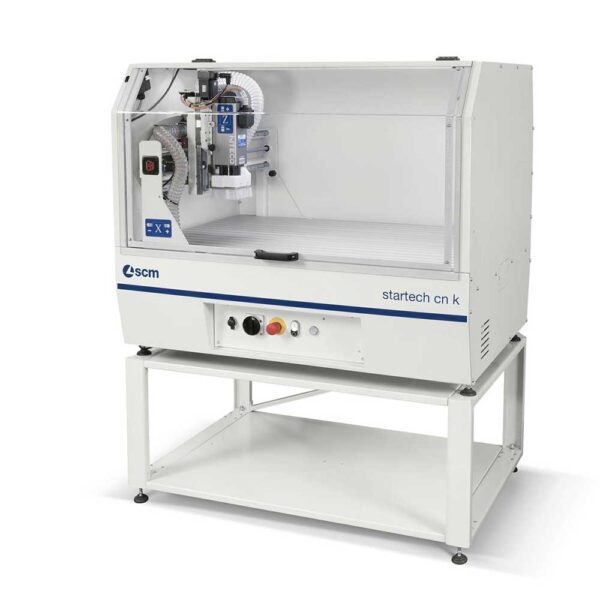
SCM Startech CN K
The Startech CN K is a compact CNC machining center for milling, decoration, engraving, signboard creation, 3D prototyping, and flexible production. It is suited to smaller CNC applications where a compact footprint and controlled machining environment matter.
Key specs: compact worktable format, integrated enclosure, CNC milling/engraving capability, electrospindle routing, G-code workflow, and flexible machining for smaller parts, signs, prototypes, and specialty components.
View SCM Startech CN K →Where flat table and nesting CNC routers fit in a modern shop.
A nesting CNC router is the control point between design software and physical production. It should not be selected only by table size. The real question is how it supports the shop’s cutlist, material flow, drilling requirements, labeling, edgebanding, assembly, sanding, painting, reporting, and future capacity.
Buying questions Titan should ask before quoting a nesting CNC.
The correct CNC depends on the shop’s material mix, production targets, software stack, downstream bottlenecks, and growth plan. This is where Titan can turn a machine quote into a real production strategy.
How many sheets per shift?
Sheet volume determines table size, unloading strategy, tool changer capacity, drilling capacity, vacuum requirements, and whether automatic loading should be considered.
What are you cutting?
MDF, melamine, plywood, veneer, high gloss, matte, plastics, composites, compact materials, and solid wood all have different tooling, vacuum, and dust requirements.
Where do the parts go next?
If parts go to an edgebander, the CNC edge must be clean. If they go to paint, the profile must sand cleanly. If they go to assembly, drilling must be exact.
How does design become machine code?
The CNC should support the shop’s design software, CAD/CAM flow, nesting workflow, labeling, barcoding, operator prompts, tool libraries, and reporting goals.
Common nesting CNC production problems Titan can help solve.
Most CNC problems are not isolated to the CNC. They show up later at the edgebander, sander, paint line, assembly bench, or install site. The machine, tooling, material, vacuum, dust collection, and software all have to work together.
Build the full CNC production cell.
A nesting CNC should be planned with the machines around it. The best CNC cell is not just fast at cutting — it supports material handling, dust extraction, labeling, edgebanding, sanding, assembly, and reporting.

Control MDF Dust and Chip Load
Dust extraction affects tool heat, cut quality, operator cleanup, finishing quality, sanding quality, machine life, and shop air quality.
View Dust Collection →
Feed the Edgebander Correctly
Clean CNC edges reduce pre-mill load, glue-line defects, chip-out, handling damage, and remake cost at the edgebander.
View Edgebanders →
Move Parts Without Losing Money
Loading, unloading, labeling, carts, conveyors, returns, and sort logic determine whether the CNC creates throughput or just creates piles.
View Material Handling →Plan the CNC around the production system — not just the table size.
Tell Titan your material mix, sheet volume, software flow, part size range, drilling needs, edgebanding strategy, dust collection setup, shop layout, and growth plan. We can help match the right SCM flat table or nesting CNC router to the real production problem.