
Pitch flexibility
Joint pitch can change
Drawers with different joint pitches can be glued without customized parts or nozzles.
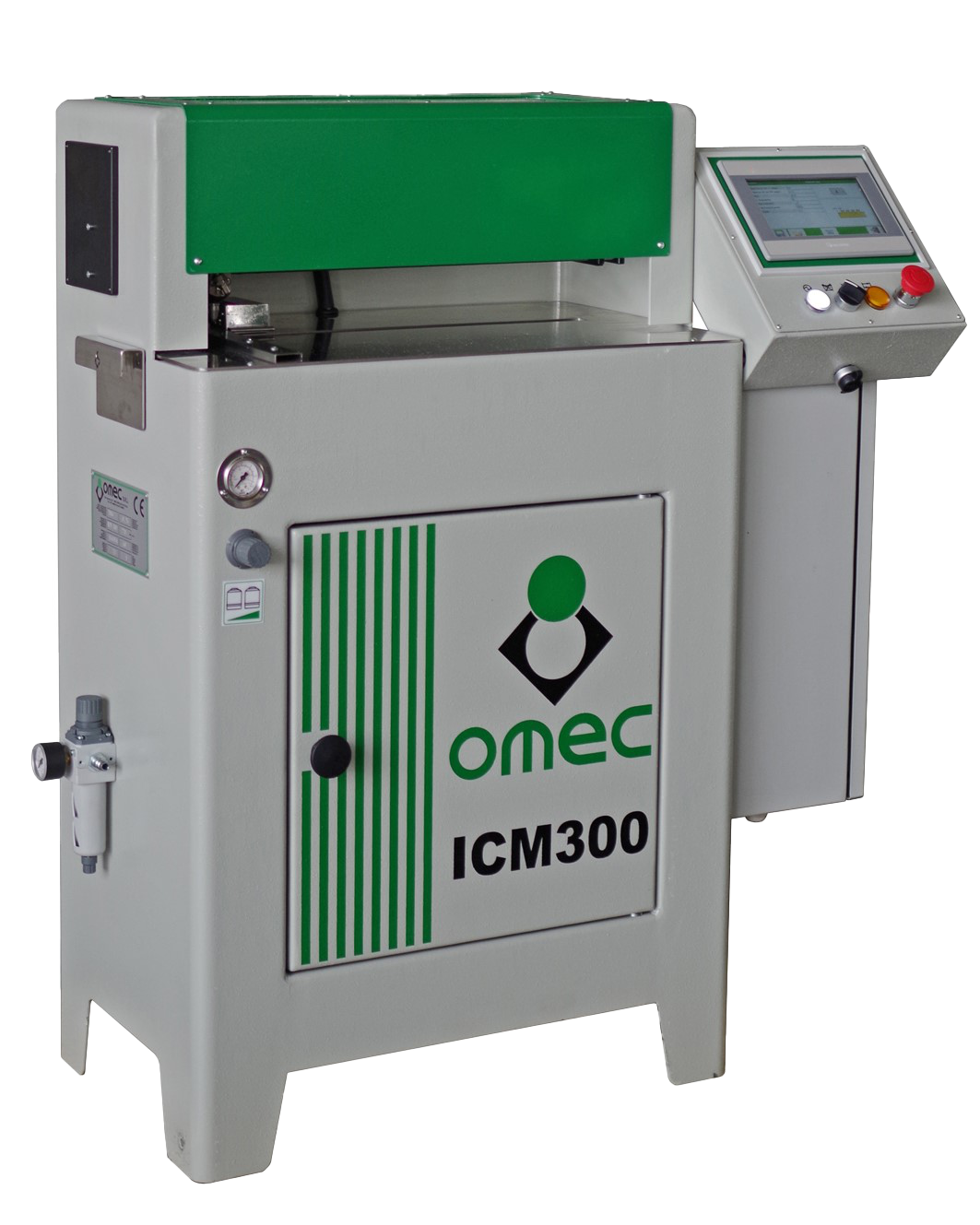
A manual OMEC gluing machine for drawer components with dovetail joints, parallel joints and lock pins. The ICM 300 works across changing joint pitches without format-specific parts or nozzles, and drawer-width changes do not require machine adjustment.
Changing drawer widths and joint pitches can create repeated glue-system changeover if the application depends on format-specific parts or nozzles.
The ICM 300 uses a spray-nozzle architecture with glue-quantity adjustment and is designed to cover multiple joint types and pitches without format-specific nozzles.
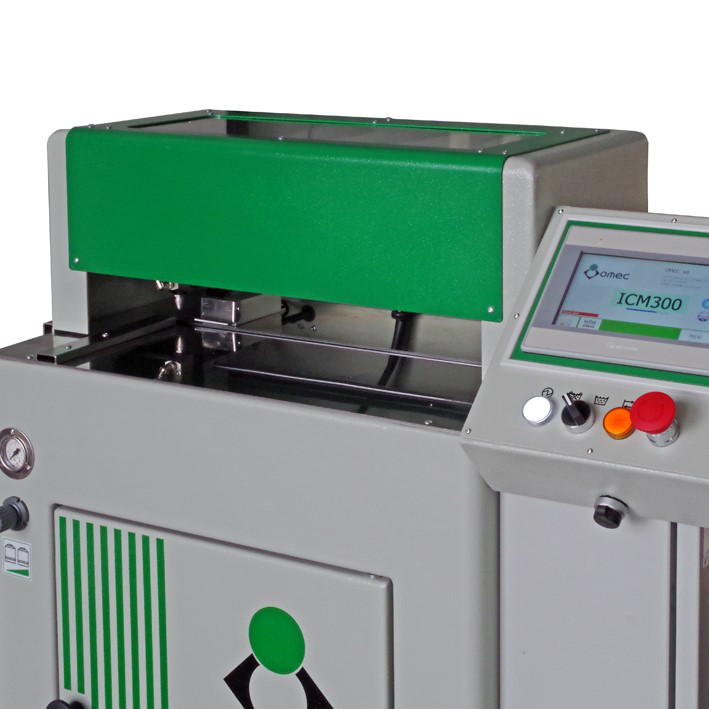
Machine commands are handled from an on-board control panel while the gluing process remains a manual-machine workflow.
Start with the manufacturing problem
The ICM 300 is built around flexibility at the glue-application station. Different joint pitches can be glued without custom parts or format nozzles, and drawer-width changes do not require adjustment.
Drawers with different joint pitches can be glued without customized parts or nozzles.
No machine adjustment is required when drawer width changes.
The ICM 300 includes a system for adjusting the quantity of glue delivered.
Practical output depends on operator handling, joint mix, adhesive application and downstream clamping capacity.
Application fit
The ICM 300 is strongest where the drawer program includes dovetails, parallel joints or lock pins across changing pitches and widths. It remains a manual gluing platform intended for flexible drawer production.
Dovetail-jointed drawer components are supported.
Parallel-jointed drawer components are supported.
Lock-pin drawer components are supported.
Changing joint pitches do not require custom format parts or nozzles.
The machine is specifically described as requiring no adjustment when drawer width changes.
The ICM 300 is a manual gluing machine; automatic-feed requirements require a different system architecture.
Select the gluing process from the joint backwards
The ICM 300’s flexibility does not remove the need to qualify the actual drawer construction and adhesive process. Machine selection should be based on joint type, material and the workpiece envelope.
Dovetail, parallel joint or lock pin.
Confirm the complete pitch range used in production even though the machine is designed for any joint pitch.
Validate length, width, thickness and depth against the machine’s dimensional range.
The ICM 300 is specified for vinyl glue at 8,000 mPa.s. Final adhesive compatibility remains part of the process qualification.
Balance manual gluing with the drawer press/clamp and the actual production sequence.
Machine architecture / work cycle
The ICM 300 uses a straightforward manual architecture centered on the gluing process, special spray nozzle, glue-quantity adjustment and on-board controls.
The ICM 300 is a manual drawer gluing machine.
Machine control is performed through a panel mounted on the machine.
The amount of adhesive delivered can be adjusted to suit the qualified process.
Different joint pitches do not require customized parts or nozzles.
Joint / gluing capability
The ICM 300 supports dovetail, straight/parallel and lock-pin joint styles across a flexible manual gluing workflow.
Glued-joint capability
Joint-pitch and drawer-width flexibility make the ICM 300 useful where drawer families change while the process remains within the machine’s joint and workpiece scope.
Technical specifications
Core machine data for application planning and installation review.
| Field | Metric value | Imperial / application note |
|---|---|---|
| Machine type | Manual drawer gluing machine | Manual glue-application workflow |
| Installed power | 0.25 kW | ~0.34 hp |
| Working pressure | 0.7 MPa | ~101.5 psi |
| Glue type / viscosity | Vinyl glue · 8,000 mPa.s | Final adhesive compatibility is confirmed for the application |
| Machine weight | 94 kg | ~207 lb |
| Packed machine weight | 130 kg | ~287 lb |
| Overall dimensions L × W × H | 100 × 40 × 105 cm | ~39.4 × 15.7 × 41.3 in |
Dimensional range / workpiece envelope
Use the dimensional limits below as the basis for application qualification.
Controls / operator workflow
Machine commands are handled from the on-board control panel while glue delivery remains adjustable within the manual gluing process.
On-board control
The control scope centers on machine commands and glue-quantity adjustment; the ICM 300 remains a manual gluing platform.
Glue / nozzle architecture
The special spray nozzle is designed around flexible joint pitches without format-specific nozzle changes, while glue quantity remains adjustable for the qualified adhesive process.
Vinyl glue is specified for the ICM 300.
The specified vinyl-glue viscosity is 8,000 mPa.s.
Glue delivery quantity can be adjusted on the machine.
The nozzle is designed around joint-pitch flexibility without format-specific nozzle changes.
Utilities / deployment
Machine power, working pressure, weight and footprint define the basic installation envelope. Final voltage, phase, frequency and protection are confirmed for the supplied machine.
Installed machine power is 0.25 kW.
Working pressure is 0.7 MPa—approximately 101.5 psi.
The machine itself is compact relative to many downstream assembly stations.
Voltage, phase, frequency and protection are confirmed for the supplied Canadian machine.
Final glue setup, machine checks and operating practice are completed through qualified commissioning and the supplied operating documentation.
Production-rate framework
Practical output depends on the actual joint mix, operator handling, adhesive process and downstream clamp capacity.
Use representative parts and operator handling to establish practical cell output.
Dovetail, parallel and lock-pin drawer programs can create different handling requirements.
The ICM 300 is a manual gluing machine, so cell output must be studied from the actual process.
The gluing station only creates useful drawer output if the downstream assembly/clamping process can keep pace.
Ownership / changeover
Joint-pitch and drawer-width changes do not require format-specific parts/nozzles or width adjustment. Adhesive condition and qualified operating procedures still govern the process.
Track the actual drawer joint and workpiece range even though the nozzle architecture is pitch-flexible.
Use the machine’s glue-quantity adjustment within the qualified adhesive process.
Use the supplied operating procedure for nozzle cleaning, adhesive handling and service.
Maintain practical access to the glue system, control panel and machine cabinet for qualified inspection and maintenance.
Production-line integration
The manual gluing station is most useful when the upstream joint process and downstream clamp are selected around the same drawer family.
Prepare dovetail, parallel or lock-pin components using the qualified upstream machine/process.
Bring the prepared component into the ICM 300 gluing step within the dimensional envelope.
Use the spray-nozzle architecture and glue-quantity adjustment for the qualified vinyl-glue process.
Transfer glued components into the appropriate drawer press or clamp.
Set practical output from real operator handling and downstream clamp capacity.
Standard configuration / options
Standard equipment includes an adjustment/maintenance tool kit and the machine manual; A44 is the named water-tank option.
Included as standard equipment.
The machine manual is included as standard supply.
A44 is the named optional water-tank feature supplied on specific customer request.
Business-case framework
The business case should compare current glue application, drawer-width and joint-pitch changes, glue consistency, operator handling and downstream clamping.
Measure current glue-application time and variation across the real drawer range.
Quantify how much time is currently spent changing nozzles, fixtures or setup between drawer families.
Evaluate current glue quantity consistency and the qualified vinyl-glue process.
Compare the manual gluing cell with upstream joint machining and downstream clamp capacity.
Application data package
ICM 300 qualification is strongest when the full drawer family and actual glue specification are available rather than only one nominal part.
Dovetail, parallel or lock pin plus the minimum/maximum joint pitches used in production.
Length, width, thickness and depth across the full drawer family.
Current vinyl glue, viscosity/specification, current application method and any validated process requirements.
Current manual output, operators, upstream joint machine, downstream clamp, electrical service and compressed air.
Complete at quotation
Your complete OMEC ICM 300 proposal defines the drawer-joint family, workpiece dimensional range, approved vinyl-glue process, viscosity basis, glue-quantity settings, supplied adhesive-system configuration, A44 water-tank option where required, working-pressure interface, electrical configuration, shipping data, standard equipment, commissioning, operator training and role between joint machining and drawer assembly.
Final supplied adhesive-system configuration, electrical details and shipping data are confirmed in the proposal.
ICM 300 FAQ
The critical qualifiers are joint type, joint pitch, workpiece dimensions, adhesive and the required role in the full drawer line.
The ICM 300 supports dovetails, parallel joints and lock pins.
Changing joint pitches do not require customized parts or format-specific nozzles.
No machine adjustment is required when drawer width changes.
Yes. The machine includes a system for adjusting the quantity of glue delivered.
The ICM 300 is specified for vinyl glue at 8,000 mPa.s. Final adhesive compatibility remains part of the process qualification.
Practical output depends on joint mix, operator handling, adhesive application and downstream clamping capacity.
Length 150–1500 mm, width 50–450 mm, thickness 5–40 mm and depth 0–40 mm.
A44 is an optional water tank supplied on specific customer request.
OMEC ICM 300 application review
Titan can qualify the ICM 300 against the actual joint family, joint-pitch range, workpiece envelope, adhesive specification, manual cell output and downstream drawer-clamping process.
Useful inputs: dovetail/parallel/lock-pin joint, pitch range, minimum/maximum workpiece dimensions, current glue and viscosity, current application method, target output, upstream joint machine, downstream press/clamp, electrical service and compressed air.