
Process bottleneck
Manual glue application can cap line flow
The ICA 600 is designed to automate glue distribution on wine-crate sides and furniture-drawer components.
An automatic OMEC glue-application platform for the sides of wine crates and furniture drawers. Two adjustable nozzles apply vinyl glue in sections or as a continuous stream, while the work cycle runs automatically; removing one finished workpiece starts the next gluing cycle.
Repeated manual glue application can become the bottleneck between joint machining and final drawer or crate assembly.
Two adjustable nozzles can deliver vinyl glue in sections or continuously across the programmed work cycle.
The gluing cycle is automatic; operator removal of the completed workpiece triggers the next workpiece cycle while only magazine depth and nozzle position/height remain manual adjustments.
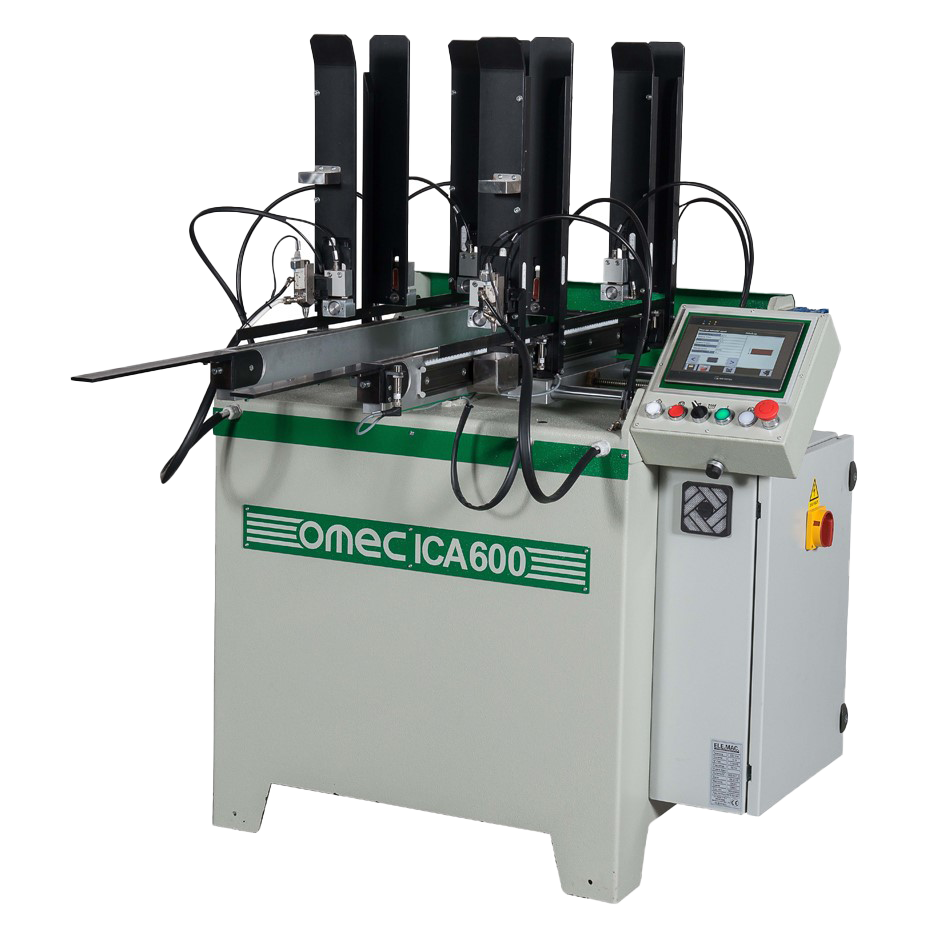
Start with the manufacturing problem
The ICA 600 automates the gluing cycle itself. Some setup and handling remain with the operator: magazine depth and nozzle position/height are manually adjusted, and removing a completed workpiece initiates the next automatic cycle.
The ICA 600 is designed to automate glue distribution on wine-crate sides and furniture-drawer components.
The nozzles can apply vinyl glue in sections or in a continuous mode.
Removing a completed workpiece starts the gluing cycle for the next workpiece automatically.
Establish practical output from the qualified workpiece, operator removal and downstream assembly conditions.
Application fit
The ICA 600 is best qualified by workpiece geometry, glue path and surrounding production flow. It is intended for wine-crate sides and furniture-drawer components; final profile compatibility should be confirmed against the actual customer part.
Sides of wine crates are a primary workpiece application.
Furniture-drawer components are also within the machine’s intended workpiece scope.
A good fit where adhesive must be deposited at intervals rather than continuously.
The same two-nozzle platform can also apply a continuous stream.
Best suited where the glue application itself should cycle automatically while an operator remains part of workpiece handling.
For lower automation or a different workpiece-flow strategy, qualify ICM 300 separately rather than blending the two machines.
Select the gluing process from the workpiece backwards
ICA 600 qualification starts with the actual wine-crate or drawer component, then closes nozzle placement, magazine setup, adhesive and downstream assembly.
Wine-crate side or furniture-drawer component, including the complete dimensional family.
Sectional or continuous application and the locations that the two nozzles must reach.
Validate length, width, thickness and depth against the stated workpiece limits.
Use vinyl glue at 8,000 mPa.s as the stated machine basis, then qualify the final adhesive process for the application.
Match the automatic glue cycle to operator unloading and the downstream press, clamp or box-assembly operation.
Machine architecture / work cycle
The ICA 600’s defining architecture is not CNC positioning. It is an automatic glue cycle with manual setup of magazine depth and nozzle position/height, plus operator removal between cycles.
The machine uses two adjustable glue nozzles for the workpiece application.
The same nozzles can distribute vinyl glue in sections or continuously.
OMEC describes the work cycle as fully automatic.
Magazine depth and nozzle position/height remain manual settings.
Glue-application capability
The ICA 600 applies glue directly to machined wood components. Qualification should therefore start with the real profile, required glue path and nozzle position rather than a generic joint assumption.
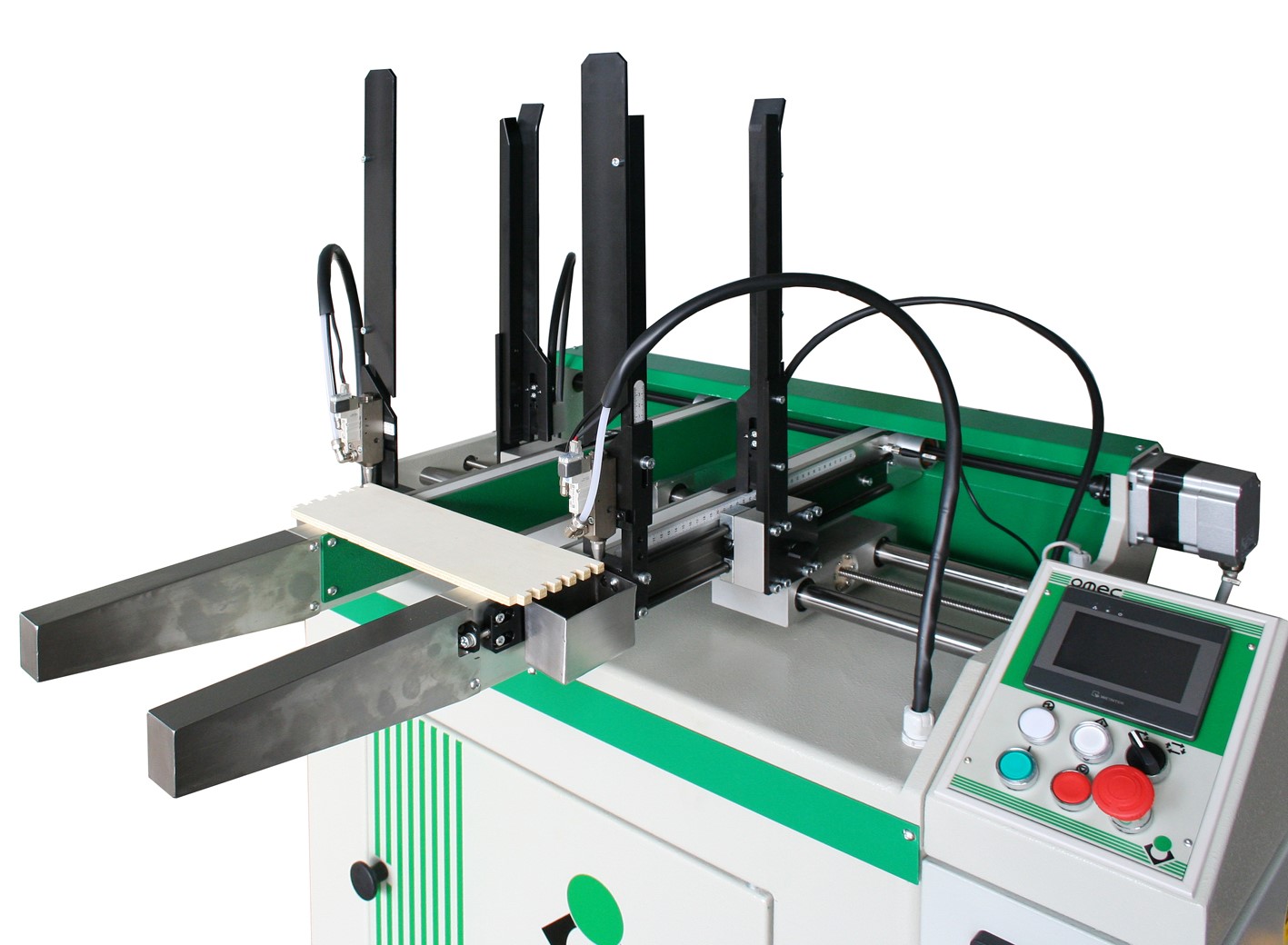
Workpiece / nozzle relationship
Use the customer part to confirm nozzle position, glue location and sectional or continuous application. Glue-bead size, cure time and bond-performance requirements remain part of the adhesive/process qualification.
Technical framework
Use the stable machine values below for application planning. Configuration-dependent utilities, tank capacity, weights and shipping details are confirmed for the machine supplied.
| Field | Metric value | Imperial / note |
|---|---|---|
| Machine type | Automatic gluing machine | |
| Installed power | 0.5 kW | ~0.67 hp |
| Glue type / viscosity | Vinyl glue · 8,000 mPa.s | |
| Overall dimensions L × W × H | 110 × 128 × 144 cm | ~43.3 × 50.4 × 56.7 in |
Working pressure, glue-tank capacity, machine/packed weight and packing dimensions are confirmed against the exact supplied machine before order release.
Dimensional range / workpiece envelope
Use the stated length, width, thickness and depth limits to screen the complete workpiece family before nozzle position and glue-path qualification.
Two adjustable nozzles are manually positioned in height and location for the qualified workpiece.
Controls / automation / operator workflow
The ICA 600 combines automatic cycle logic with manual magazine-depth and nozzle position/height adjustments. Controls are located on the machine’s built-in panel.
Machine controls are located on the built-in control panel.
Removing the completed workpiece automatically starts the gluing cycle of the next workpiece.
Magazine depth remains a manual adjustment.
The nozzle position remains manually adjusted.
Nozzle height is also a manual setup variable.
Use the machine’s defined automatic cycle and manual setup controls as the operating basis.
Glue / nozzle architecture
Two adjustable nozzles support sectional or continuous vinyl-glue application. The special spray-nozzle design is intended to avoid routine end-of-cycle nozzle cleaning.
Both nozzles can be repositioned for the workpiece application.
The nozzles can distribute vinyl glue in sections.
The nozzles can also deliver a continuous glue stream.
Vinyl glue is the specified adhesive basis.
The specified viscosity field is 8,000 mPa.s.
The special nozzle type is intended to require no cleaning at the end of the work cycle. Final operating practice follows the supplied machine and adhesive documentation.
Utilities / deployment
Installed power is 0.5 kW. Final pressure requirement, glue-tank capacity, electrical service and installation details are confirmed for the supplied machine before commissioning.
Use 0.5 kW as the installed-power basis for application planning.
Voltage, phase, frequency and protection remain tied to the machine supplied for the Canadian installation.
Plan access for magazine setup, nozzle adjustment, completed-workpiece removal and downstream transfer.
Final glue setup, cycle checks and operating practice belong to qualified commissioning and the supplied machine documentation.
Production-rate framework
Automatic glue cycling reduces repetitive application work, but practical output still depends on magazine presentation, operator removal, glue path, workpiece mix and downstream assembly capacity.
Measure the complete part-to-part cycle on the qualified workpiece rather than relying on an assumed hourly figure.
The next-piece cycle begins automatically, but cell output still includes operator removal and downstream handling.
Sectional and continuous application requirements can affect the actual cycle.
The glue station only improves line flow if the press, clamp or box-assembly process can absorb the workpieces.
Ownership / changeover
The machine reduces repetitive glue application, while the operator remains responsible for magazine depth, nozzle position/height and maintaining the qualified adhesive process.
Keep magazine setup tied to the actual workpiece family.
Nozzle placement must match the qualified glue path and workpiece profile.
Use the approved vinyl-glue process and follow the adhesive manufacturer’s storage/handling requirements.
Follow the supplied service procedures for glue, pressure and electrical systems.
Production-line integration
Its automatic cycle is most useful when the upstream part process can keep the magazine supplied and the downstream assembly operation can accept glued components at a consistent pace.
Machine the wine-crate or drawer components to the qualified geometry.
Adjust magazine depth plus nozzle position and height for the workpiece family.
Apply sectional or continuous vinyl glue through the two adjustable nozzles.
Removal of the completed workpiece triggers the next automatic gluing cycle.
Move the glued component into the appropriate crate or drawer assembly process.
Standard configuration / options
The supplied configuration includes the adjustment/maintenance tool kit and user/instruction manual. A44 is the named water-tank option for applications that require it.
Included as standard equipment.
Included in the standard machine supply.
A44 is the optional water tank for applications that require it.
Workpiece qualification
Final suitability should be confirmed against the customer’s actual profile, required glue path and nozzle position.
Business-case framework
Compare manual glue labour, workpiece handling, changeover, adhesive consistency and downstream assembly capacity. Use measured cycle data rather than assumed hourly rates or generic labour-saving percentages.
Measure the manual time currently spent applying adhesive to the exact workpiece family.
Measure operator presentation, removal and transfer time around the existing process.
Count magazine-depth and nozzle-position/height changes across the product mix.
Compare the glue station against downstream pressing, clamping or crate assembly.
Application data package
ICA 600 qualification should use actual component drawings, adhesive requirements, dimensional range and production-flow targets so nozzle setup and automatic-cycle fit can be reviewed against the real application.
Wine-crate side or furniture-drawer component, including material and machined profile.
Minimum/maximum length, width, thickness and depth across the complete product family.
Sectional or continuous application, locations, current adhesive and viscosity/specification.
Current output, target output, operator handling, downstream assembly, electrical service and available pressure supply.
Complete at quotation
Your OMEC ICA 600 proposal defines the workpiece family, dimensional range, sectional/continuous glue path, nozzle setup, magazine configuration, vinyl-glue process, supplied glue-tank capacity, working-pressure requirement, electrical configuration, A44 water-tank option where required, final machine/shipping details, commissioning, operator training and role in the production line.
Configuration-dependent utility, tank, weight and shipping values are confirmed against the exact machine being supplied.
ICA 600 FAQ
The main qualification gates are workpiece geometry, glue path, automatic-cycle fit, manual adjustment requirements and the supplied utility/tank configuration.
Sides of wine crates and furniture drawers.
The ICA 600 uses two adjustable nozzles.
No. The nozzles can spread vinyl glue in sections or in a continuous mode.
Yes. Removing the completed workpiece starts the next gluing cycle automatically.
Magazine depth plus nozzle position and nozzle height.
Vinyl glue at 8,000 mPa.s.
Use the measured part-to-part cycle with the qualified workpiece, operator removal and downstream assembly conditions.
Length 150–600 mm, width 60–450 mm, thickness 4–25 mm and depth 0–25 mm.
A44 is the optional water tank for applications that require it.
OMEC ICA 600 application review
Titan can qualify the ICA 600 against wine-crate or drawer-component geometry, sectional/continuous glue requirements, product mix, automatic-cycle role, adhesive, utilities and downstream assembly.
Useful inputs: workpiece type, minimum/maximum dimensions, machined profile, sectional/continuous glue path, current vinyl glue and viscosity, current application method, target output, downstream assembly machine, electrical service and pressure supply.