
Panel Saws
Beam saws built for cleaner panel flow, faster cut lists, and production-grade accuracy.
Beam saws are the front-end control point for serious panel shops. Before a cabinet hits the CNC, before a panel reaches the edgebander, and before assembly starts, the sheet has to be sized accurately, safely, and repeatably. Titan supplies SCM Gabbiani beam saw solutions for craftsmen, small-to-medium production shops, and larger panel-processing workflows that need cleaner cuts, stack handling, scoring accuracy, and software-driven production control.
Beam saws are not just saws. They are production traffic control.
A beam saw controls the first high-impact operation in a panel shop: taking full-size sheets or stacks and turning them into accurate parts ready for CNC routing, edgebanding, drilling, assembly, or direct casework production. When a beam saw is selected properly, it reduces forklift chaos, improves yield, protects expensive materials, and creates a predictable front-end rhythm for the rest of the plant.
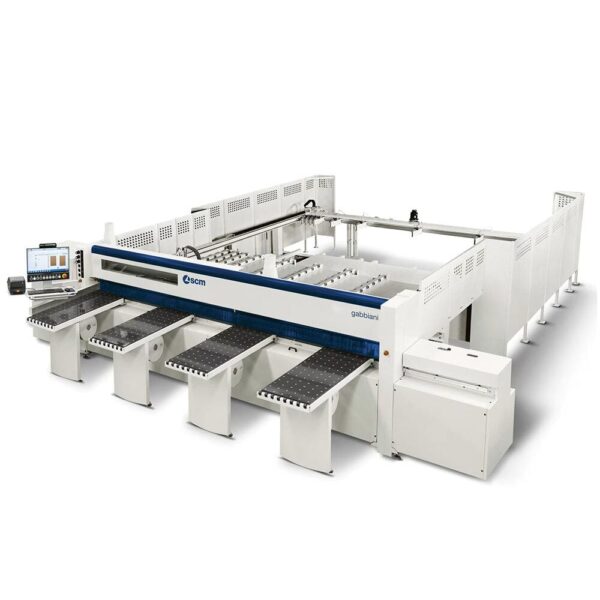
Bring Order to Panel Flow
Beam saws are ideal where panels need to be cut in volume, nested into batches, staged for downstream machines, and controlled before operators start manually moving material around the shop.
View Beam Saws →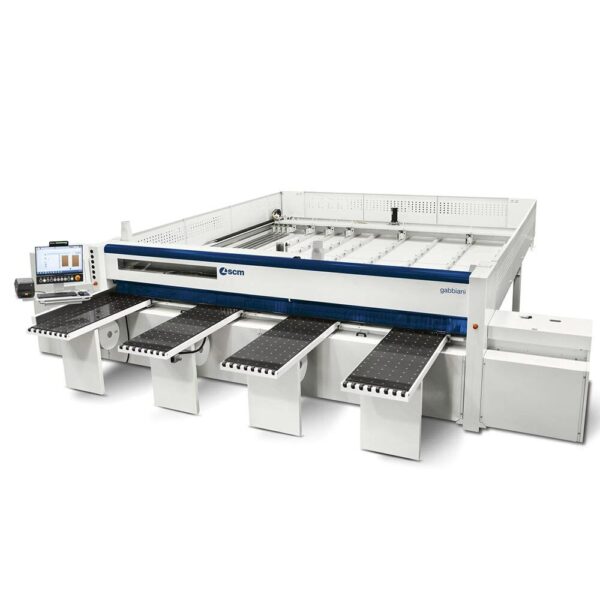
Cut Smarter, Not Just Faster
Maestro Active Cut supports programming, material management, off-cut control, end-product tracking, scraps, and workflow visibility for modern panel-processing shops.
View Gabbiani S →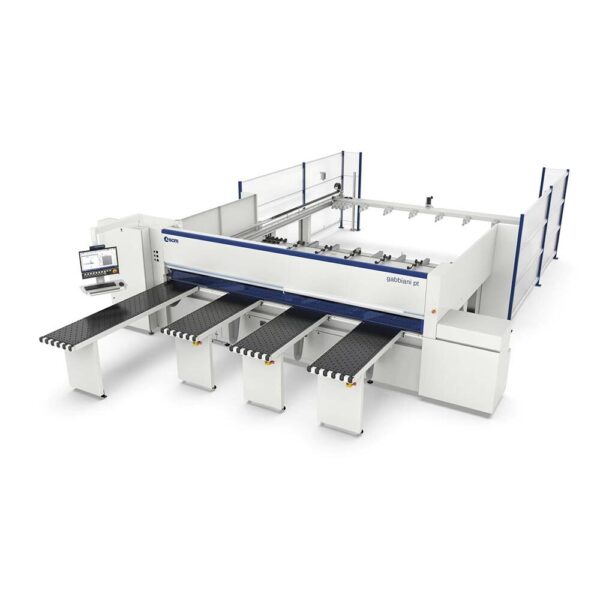
Build Around the Loading System
Platform-based beam saw workflows help shops handle stacks, reduce manual lifting, support forklift loading, and create a safer, cleaner front-end panel cell.
View Gabbiani PT →Every downstream problem gets more expensive after the first bad cut.
Poor sizing, chip-out, bad scoring, wrong off-cut handling, manual re-cuts, and uncontrolled material flow all show up later as edgebanding defects, assembly delays, remake parts, wasted sheets, and installation stress. A properly planned beam saw cell improves the entire shop, not just the saw department.
Plan My Beam Saw CellSCM beam saw lineup from Titan Equipment.
Titan’s current beam saw category includes four SCM Gabbiani models, ranging from lean, intuitive single-blade workflows to platform-based automatic horizontal panel saw solutions for stronger stack handling and higher production flow.
SCM Gabbiani ST
Built for companies that need a lean and easy workflow, the Gabbiani ST is a PC/PLC-controlled single-blade beam saw with selectable air-blowing tables, SAW-SET electronic tool adjustment, Maestro Active Cut software, and a robust lifting platform for panel stack handling.
Key specs: cutting length 3200 / 3800 / 4500 mm; cutting depth on platform 1850 / 2200 mm; stack height up to 600 mm; 115 mm blade projection; 400 / 160 mm main/scorer blades; 6 clamps.
View SCM Gabbiani ST →
SCM Gabbiani S
Designed as a single-blade beam saw for smaller companies, the Gabbiani S uses PC/PLC control, selectable air tables, Maestro Active Cut, SAW-SET, and available FLEXCUT productivity options for simultaneous rip and cross cuts.
Key specs: S95 / S115 models; cutting length 3200 / 3800 / 4500 mm; 95 or 115 mm blade projection; saw carriage variable speed 6–60 m/min with options; 380 / 160 or 400 / 160 mm main/scorer blades; 5 or 6 clamps.
View SCM Gabbiani S →
SCM Gabbiani PT
The Gabbiani PT is an automatic horizontal panel saw for craftsmen and small-to-medium companies. It adds intelligent LED guidance, platform loading, forklift-assisted stack handling, available FLEXCUT, and SAW-SET for fast electronic tool adjustment.
Key specs: PT80 / PT95 models; cutting length 3300 / 3800 / 4300 mm; platform cutting depth 1850–2200 mm; stack height up to 600 mm; 80 or 95 mm blade projection; 340 or 370 mm main blade; 200 mm scorer; 5 clamps.
View SCM Gabbiani PT →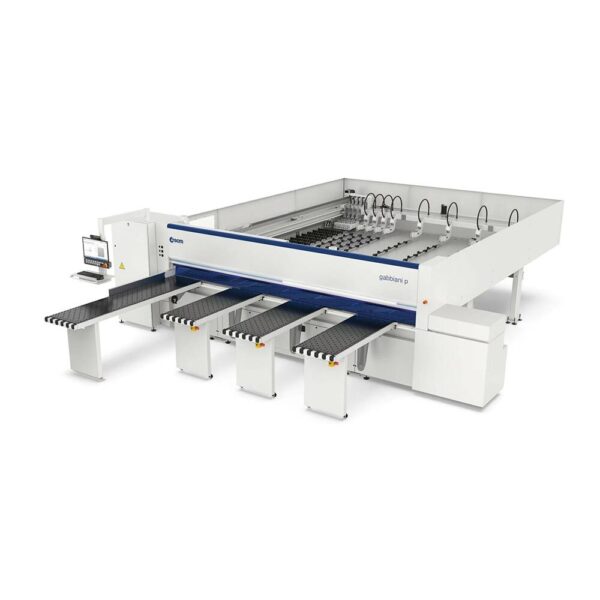
SCM Gabbiani P
The Gabbiani P is designed for streamlined cutting of wood panels and derivatives, with intelligent LED bar guidance, powerful blade carriage options, SAW-SET, and available FLEXCUT for simultaneous rip and cross cutting.
Key specs: P60 / P80 / P95 models; cutting length 3300 / 3800 / 4300 mm; 60 / 80 / 95 mm blade projection; saw carriage variable speed 6–60 m/min with options; 370 mm main blade; 200 mm scorer; 5 clamps.
View SCM Gabbiani P →Where beam saws fit in a modern panel-processing shop.
Beam saws are the front-end engine for shops that need predictable flow. They can support nested CNC production, edgebander production, direct cabinet cutting, repetitive casework batches, closet systems, commercial millwork, furniture parts, and high-volume panel sizing.
Beam saw buying questions Titan should ask before quoting.
A beam saw should be selected around production flow, not just maximum cutting length. These are the questions that separate a good quote from a machine that actually fits the shop.
How many sheets per shift?
Daily sheet volume, batch size, material mix, stack height, sheet format, and cut complexity all determine whether a lean saw or platform-based workflow is the right fit.
What are you cutting?
MDF, melamine, plywood, TFL, veneer panels, high-gloss panels, matte panels, compact material, and fibre panels all have different scoring and blade requirements.
Where do parts go next?
The saw should feed the edgebander, CNC, drilling machine, dowel cell, case clamp, assembly bench, or packaging area without creating a carting mess.
How are sheets loaded?
Forklift access, rear loading, platform loading, off-cut storage, staging racks, air tables, stack movement, and operator ergonomics matter as much as the blade motor.
Common beam saw production problems Titan can help solve.
The saw itself is only part of the system. Most production problems come from the way material, tooling, software, operators, and downstream machines interact.
Plan the beam saw around the shop you are building — not just the sheet you are cutting today.
Tell Titan your material mix, sheet volume, cut-list workflow, forklift access, downstream machines, edgebanding volume, CNC strategy, storage space, and growth plan. We can help match the right SCM Gabbiani beam saw to the real production problem.